
Four-way stretch fabric is material that stretches and snaps back in both length and width, letting a garment move with the body instead of fighting it. You need it for anything that has to flex through a full range of motion and hold its shape afterward: leggings, swimwear, compression gear, dancewear. Before buying, check the label for elastane or spandex percentage and any mention of recovery, since those two details tell you almost everything else.
TL;DR:
- Fabrics with higher spandex percentages, especially around 20%, offer better recovery for high-compression and swimwear, but lower percentages may result in sagging.
- GSM ratings above 220 ensure opacity even when stretched, making them ideal for leggings and activewear where transparency is undesirable.
- Testing stretch and recovery at home involves measuring a 4-inch swatch, stretching to check for at least 50% elongation, and confirming it returns close to original size after holding the stretch.
- Online fabric listings should specify elastane percentage, GSM, fabric width, and care instructions to prevent ordering low-quality or incompatible materials.
- Choosing the right fabric depends on the activity: nylon-spandex for durability and UV resistance in swimwear, polyester-spandex for printability, and cotton-spandex for breathability in casual wear.
Table of Contents
- How Four-Way Stretch Fabric Actually Works
- What Fabric Specs Actually Predict Performance
- How Do You Test Stretch and Recovery at Home?
- Matching Fabric to Project: Swimwear, Leggings, and More
- Sewing Stretch Fabric Without Fighting It
- What to Check Before You Order Fabric Online
- How Joy Paddling Chooses Performance Fabric
- Practical Takeaways for Sewists and Small Brands
- Ready-Made Paddling Apparel From Joy Paddling
- Sources
- FAQ
How Four-Way Stretch Fabric Actually Works
Stretch comes from two different sources, and mixing them up leads to disappointing fabric. Mechanical stretch happens when a knit structure loosens under tension, the way a plain cotton jersey gives a little at the seams. Elastomeric stretch comes from elastane, sold under brand names like Lycra or Spandex, a fiber that can extend several times its resting length and pull itself back afterward. True four-way stretch fabric needs that second kind, because mechanical give alone won’t recover reliably after repeated wear.
Construction matters just as much as fiber content. Most four-way stretch material is knitted, either on circular knitting machines or warp-knit tricot lines, which naturally allows movement in multiple directions. Woven four-way stretch fabric exists too, but it requires elastane threaded into both the warp and weft, an engineering step that adds cost and is less common outside technical activewear.
The fiber blend determines how the fabric behaves once it’s cut and sewn:
- Polyester-spandex knits, often around 75% polyester and 25% spandex, hold up well to repeated washing and take screen printing cleanly, which is why they show up in leggings and rash guards.
- Nylon-spandex blends, commonly closer to 68% nylon and 32% spandex, feel cooler against skin and resist abrasion better, a reason they dominate swimwear fabric.
- Cotton-spandex blends prioritize breathability and a soft hand over performance extremes, trading some recovery strength for comfort.
What Fabric Specs Actually Predict Performance
Composition percentages aren’t marketing filler. They predict exactly how a fabric will behave on the body. A swatch listed at 5% spandex will feel noticeably less snappy than one at 18 to 20%, and that gap shows up the moment you try to fit a waistband or a swim top.
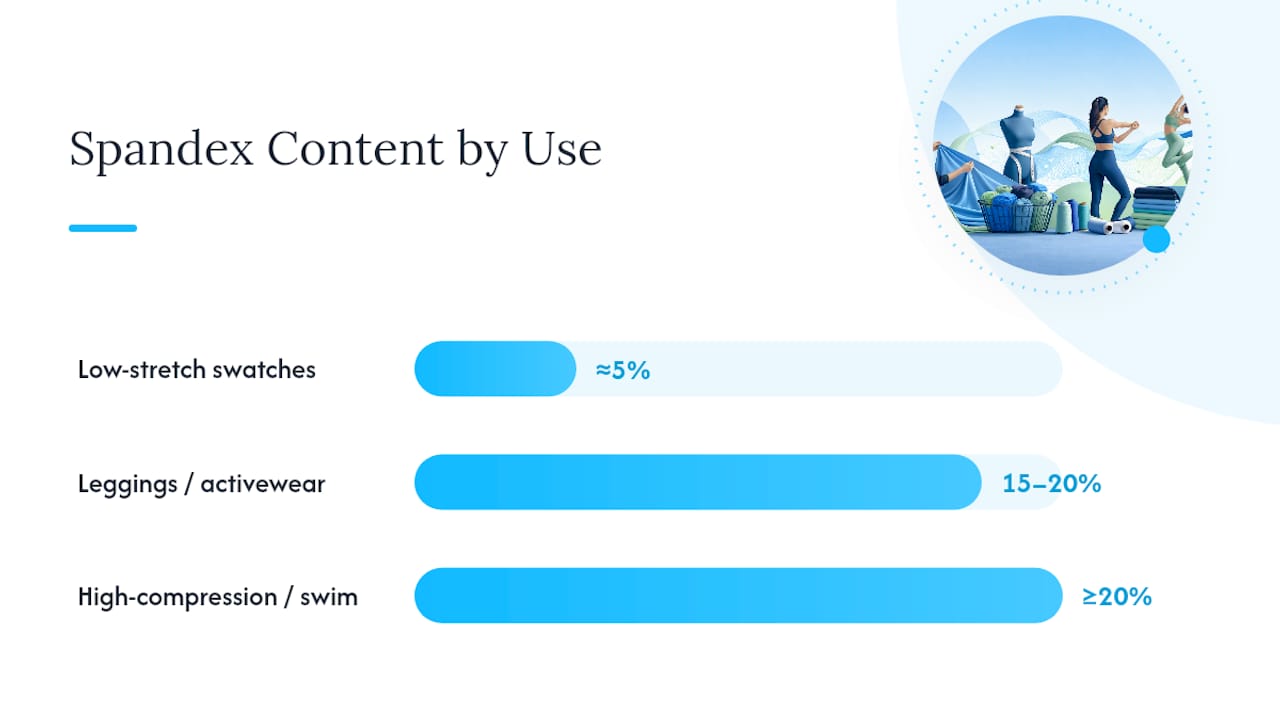
Spandex content correlates with use case in a fairly predictable band. Leggings and activewear generally run 15 to 20%. High-compression garments and competitive swimwear often push toward 20% or higher, where recovery has to survive chlorine, sweat, and UV exposure without going slack.
GSM (grams per square meter) tells you weight and, indirectly, opacity. A fabric under roughly 180 GSM often reads as sheer once stretched over a body, which matters enormously for leggings and dancewear where nobody wants a surprise under gym lighting. Fabrics in the 220 to 280 GSM range tend to hold opacity even under stretch, which is why most quality legging fabric lands in that window.
Here’s what a quick spec check should cover before you commit to yardage:
- Fiber composition and exact spandex percentage
- GSM or weight per yard, not just “medium weight”
- Stated recovery behavior, not just “stretchy”
- Chlorine or UV resistance claims for swim-specific fabric
- Printability notes if you plan to add graphics
Quick fact: four-way stretch is now treated as the baseline expectation for activewear that demands full range of motion, with the tradeoff being that it costs more and sews less forgivingly than two-way stretch options, according to a comparison of spandex stretch types.
How Do You Test Stretch and Recovery at Home?
You don’t need lab equipment to know whether a fabric will hold up. A few minutes with a ruler tells you most of what matters.
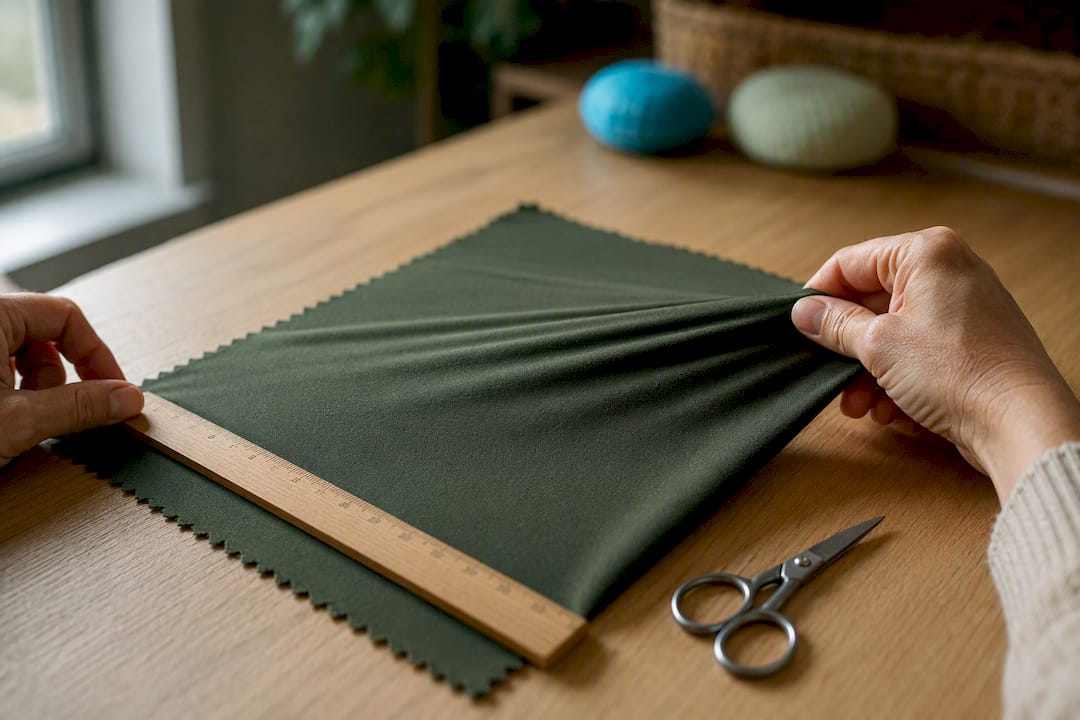
- Run the 4-inch rule. Mark two points 4 inches apart on the fabric, then stretch that section as far as it comfortably goes and measure the new distance. A fabric that stretches to 6 inches has given you 50% stretch, which is a solid working number for compression garments.
- Hold and release. Keep the fabric stretched for about 10 seconds, then let go and remeasure the marked distance immediately. It should land back at or very close to 4 inches.
- Pull on the bias. Stretch the fabric diagonally across the grain. Genuine four-way stretch fabric gives noticeably here too, not just along the straight grain.
- Check for growth. If the marked distance stays stretched out, even by a quarter inch, that’s permanent growth. Reject the fabric for anything fitted.
Substituting two-way stretch fabric when a pattern calls for four-way is one of the most common and costly mistakes home sewists make, and it shows up as pulling seams and restricted movement rather than a clean fit, according to a breakdown of two-way versus four-way stretch.
Pro Tip: Order a swatch at least 8 by 8 inches before committing to yardage. A 4-inch square doesn’t give you enough room to test both the straight grain and the bias pull accurately.
Matching Fabric to Project: Swimwear, Leggings, and More
Fabric choice should follow the job, not the other way around. A fabric that performs beautifully in a t-shirt can fail completely in a swimsuit.
- Swimwear needs nylon-spandex blends with chlorine and UV treatment, usually at higher spandex percentages so the garment holds its shape after repeated pool or saltwater exposure.
- High-compression leggings call for denser GSM, generally in the 220+ range, paired with spandex content near 18 to 20% for support that doesn’t sag by hour two.
- Dance and performance wear prioritizes opacity above almost everything else, since stage lighting exposes any sheerness instantly, plus a knit stable enough to handle sequins or bonded trims without puckering.
- Casual fitted garments, think t-shirts and everyday leggings, do well with cotton-spandex blends around 95% cotton and 5% spandex, trading some recovery power for softness and breathability that holds up to daily wear, per product specs from cotton-spandex suppliers.
Polyester-spandex and nylon-spandex each solve a different problem. Polyester blends print cleanly and survive washing without fading, which makes them a default for graphic activewear. Nylon blends run cooler and resist abrasion better, which is why competitive swim brands lean toward them even though they cost more.
Sewing Stretch Fabric Without Fighting It
Stretch fabric punishes the wrong needle faster than almost any other material. A sharp needle meant for wovens will pierce and cut the knit’s fibers, leading to runs that show up weeks after the garment is finished. Switch to a ballpoint or stretch needle, which slides between fibers instead of slicing them, and pair it with polyester thread, since polyester has enough give to move with the fabric instead of snapping under stress.
Stitch selection matters just as much as the needle:
- Use a narrow zigzag or an overlock/serger stitch instead of a straight stitch, which will pop the first time the seam stretches.
- Set differential feed on a serger to prevent wavy, stretched-out seams, especially on lighter knits.
- Stabilize shoulder seams and waistbands with clear elastic or fusible stay tape to stop them from stretching out permanently over time.
- Shorten stitch length slightly on high-spandex fabric to ease in a little extra fabric without puckering.
Cutting deserves care too. Stretch knits roll at the edges and shift on the cutting table, so pin generously or use pattern weights instead of letting the fabric slide while you cut. Press with a synthetic-safe setting and light steam. Too much heat can scorch spandex fibers and permanently kill the recovery you tested for in the first place.
Pro Tip: If your machine keeps skipping stitches on a high-spandex fabric, drop the presser foot pressure slightly before switching needles. Often the fabric is being pushed forward faster than the needle can catch it.
High-spandex, high-compression fabrics sometimes need a walking foot in addition to differential feed, since the extra fiber content makes even feed-dog machines struggle to move the layers evenly, a detail confirmed in guidance on sewing stretch fabric.
What to Check Before You Order Fabric Online
Online listings vary wildly in how much real information they include, so knowing what to look for saves you from a wasted order.
- Confirm the exact elastane percentage, not a vague “stretchy” claim. Listings that skip this number are usually hiding a low-spandex fabric.
- Check GSM or ounces per yard. If a listing only says “medium weight,” ask before ordering, especially for leggings where opacity depends on it.
- Note the fabric width. A 58 inch width cuts differently than a 60 inch one, and pattern layouts assume a specific figure.
- Read the care instructions. Machine washable is common, but chlorine resistance and UV treatment are usually called out separately for swimwear.
- Order a swatch first, and pre-wash it before testing stretch and recovery, since some finishes loosen slightly after the first wash cycle.
Vague marketing language like “premium stretch” or “buttery soft” tells you nothing measurable. Push past it and ask the seller directly for composition and GSM if the listing doesn’t state them.
How Joy Paddling Chooses Performance Fabric
The company builds paddling apparel around key priorities: fit that survives repeated paddling motion, fast recovery after stretching wet against water sports gear, and printability that keeps designs sharp after many washes. Chlorine and UV resistance are important considerations for gear exposed to sun and water.
That filter shapes what ends up in the catalog:
- Fitted tees and performance tops rely on stretch knits that move with paddling strokes instead of restricting them.
- Graphics need fabric that holds up to specialized printing methods, since standard inks can crack on high-stretch substrates without silicone-based inks or adjusted curing, a detail confirmed in technical notes on printing over stretch fabric.
- The payoff is practical: gear that stays comfortable through a full day on the water and looks the same after the twentieth wash as it did on day one.
Practical Takeaways for Sewists and Small Brands
Test before you buy in bulk. The 4-inch rule takes two minutes and saves you from a return shipment or a ruined production run. Get the needle and stitch right before you blame the fabric for skipped stitches or wavy seams.
Four-way stretch isn’t optional for anything that demands real range of motion, but it’s genuine overkill for a loose, non-fitted top. Spend the extra money where recovery actually gets tested, and save it where a two-way knit does the job just as well.
— Fillip
Ready-Made Paddling Apparel From Joy Paddling
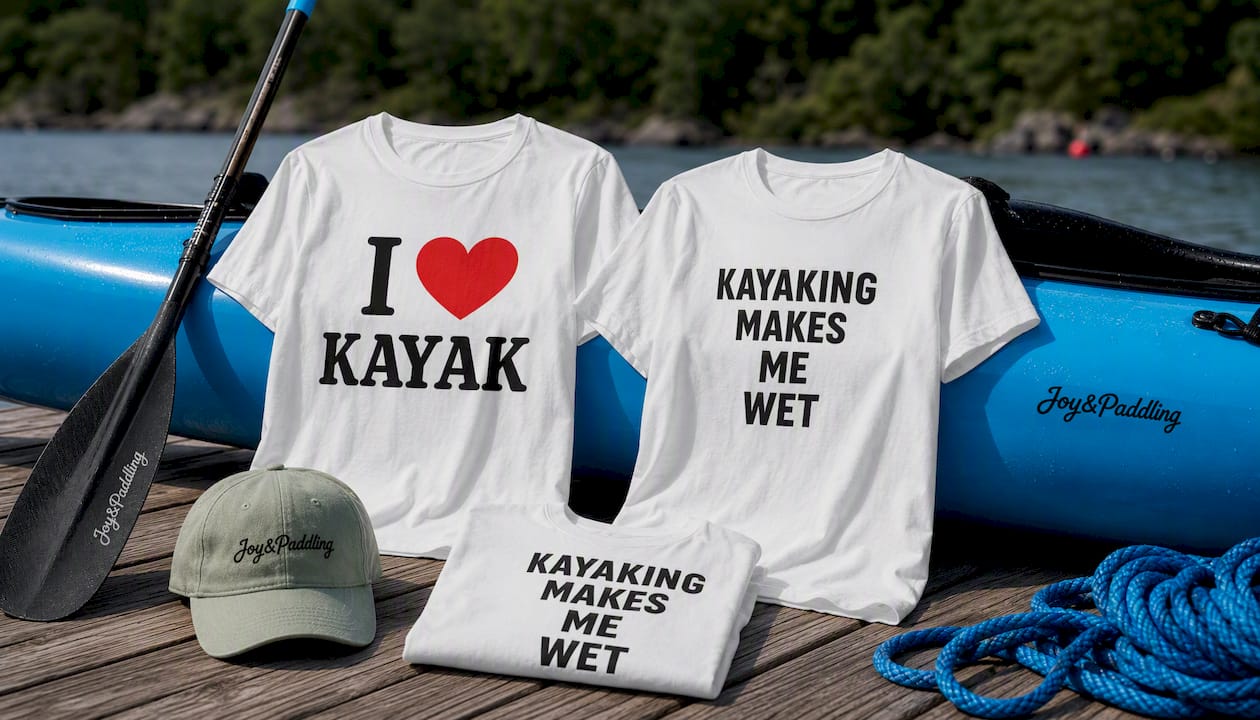
If sewing your own gear isn’t the plan, ready-to-wear pieces are available with performance fits designed for paddling, so you skip the swatch testing and needle troubleshooting entirely. The I Love Kayak T-Shirt and the Kayaking Makes Me Wet T-Shirt both use stretch-ready fabric built to move through paddling strokes and keep graphics intact wash after wash.
Whether you want a casual top for the drive to the launch point or something to wear right on the water, the full T-shirt prints collection covers a range of paddling-specific designs, and the accessories lineup rounds out the kit with the waterproof and protective gear that fabric alone can’t handle. Check sizing on each product page and order the fit that matches how you actually paddle.
Sources
For deeper technical detail beyond this guide, the sourcing breakdown at LeelineWear covers the 4-inch test in more depth, while SpandexByYard breaks down stretch percentage ranges by garment type. Readers curious about consumer demand for move-ready apparel can also see Movira’s overview of why shoppers are switching to flexible performance clothing.
- Two-Way vs Four-Way Stretch Fabrics | Minerva Patterns
- 4Way Stretch Polyester Spandex Knit Fabric - FAB1235
FAQ
What Is a Four-Way Stretch Fabric?
It’s fabric that stretches in both the lengthwise and widthwise directions and recovers its original shape afterward, unlike two-way stretch fabric, which only gives in one direction.
Is Four-Way Stretch Good for Clothing?
Yes, for anything requiring full range of motion, like activewear, swimwear, and dancewear, since it moves with the body and resists the seam stress that comes from substituting a two-way stretch fabric in a four-way pattern.
What Is an Example of a Four-Way Stretch Fabric?
Common examples include polyester-spandex and nylon-spandex knits, along with cotton-spandex blends for casual fitted garments, each suited to different levels of compression and durability.
What Is Four-Way Stretch Knit Fabric?
It’s a knitted fabric, usually circular or warp-knit, that combines a base fiber like polyester, nylon, or cotton with elastane to create stretch and recovery in every direction. Joypaddling relies on these knits for fitted apparel that has to hold shape through repeated paddling motion.